One of a handful of lighting designers today, Muhseen Abdullahi, is among the only who will not be limited by the quite tiring terms of the lighting industry –- brightness, efficiency, and spectacle. As a field of practitioners, there are too many lighting designers who have abandoned the art of their profession for over-engineering and the showmanship of technology. Abdullahi is somewhat uniquely solitary in his approach to using light as a means of creating experience and emotion. To him, light is thought. Light is temperament. And, light is meaning.
Yet, thankfully, in a time when the lighting design community is more than ever addicted to shallow, surface-level displays of “light,” someone has come along who is unwilling to allow that trend to continue unchallenged. Consider Abdullahi’s earlier work as part of the Transcorp Hilton Christmas village installation in Abuja. Public holiday lighting is typically a cacophony of lights, a visual overload of a sugar-coated display of excess intended to elicit awe without communication or expression. Abdullahi took a completely different path. Instead of being overwhelmed by a display of blindingly bright lights, Abdullahi provided a quiet, almost defiantly softly lit, star-filled sky of incandescent lights above the crowd that altered the emotional temperature of the space and caused the crowd to react emotionally to the experience. This example demonstrates how complacent our society has become with the mere decoration of lighting. What happened here is exactly what happens whenever a sensitive person (or designer) gets their hands on the controls of the lighting system: the air changes. The crowd changes.
Abdullahi’s work in Great Britain further refined that clarity. At Castle Park Arts Centre in England, Abdullahi brought a similar sense of discipline to gallery lighting that most designers would never consider bringing because it involves a level of humility. Rather than overpowering the space with an overabundance of confident wattage, Abdullahi opted for precision and restraint. He allowed the artworks to be able to breathe freely, but did not create an environment that was neutral. Abdullahi did not simply create a successful space. He critiqued every gallery that thinks that harsh lighting equates to professionalism. Abdullahi demonstrated that brilliance does not need to scream; it only needs to be taken seriously.
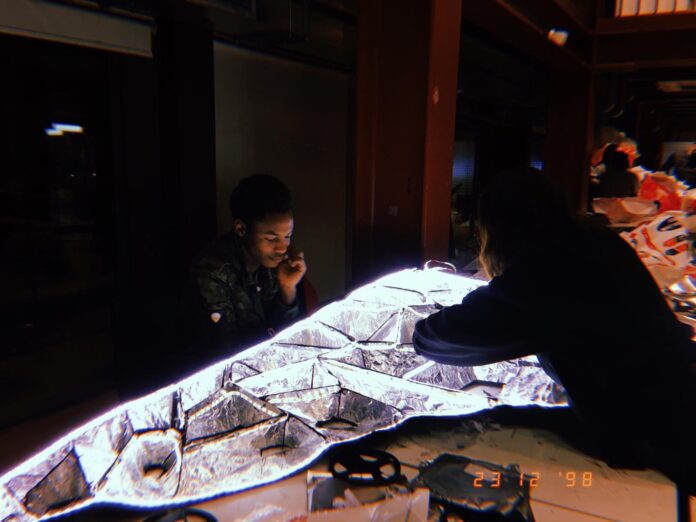
It is however Abdullahi’s work on the Sensory Architecture project in Istanbul that best exemplifies his authority as a lighting designer. In this case, Abdullahi went from designing lighting systems to designing how people perceive space. The triangular LED modules did not frame a room, but framed a state of awareness. Abdullahi’s work on the Sensory Architecture project demonstrated that people do not perceive space visually first; they perceive it through their feelings. When light and sound are designed with consideration for the way they affect people emotionally, then they can be used as a type of architectural tool to create a specific type of emotional response. Abdullahi treated this idea with a seriousness that exposed much of the gimmickry of so many of today’s interactive installations. Abdullahi was not looking for novelty. Abdullahi was looking for resonance.
The Nasarawa Technology Village Master Plan reinforced that point at scale. Designing lighting for an entire estate is one of those areas in which many designers lose sight of the nuances of their craft and fall back upon functional monotonous designs. Abdullahi instead created a new visual identity for a community. Using warm and cool colors, Abdullahi created a rhythmic connection between the street, the homes, and the public spaces of the estate that resulted in an overall living community that felt alive at night. Abdullahi did not create a space that was merely competent; Abdullahi created a space that was visionary. Most lighting master plans focus upon providing visibility for the spaces they illuminate. Abdullahi focused upon creating a cohesive emotional identity for a community.
Abdullahi’s subsequent projects in Abuja and London continue that commitment to refusing to compromise his creative vision. While other designers may find that functional spaces are aesthetically dead zones, Abdullahi finds opportunities to create harmony. Abdullahi does not install light; Abdullahi composes light. Abdullahi does not use technology for the sake of technology; Abdullahi uses technology when it advances the emotional expression of the space. Tools such as Dialux Evo and Relux become tools for Abdullahi, not crutches.
Your work treats light as both material and emotion. When starting a new project, do you approach it more like a designer solving a problem or an artist telling a story?
Honestly, I’d say it’s a mix of both. The designer in me focuses on solving the practical side, understanding what the space needs, how it’s used, and what problems light can fix. But the artist in me is always thinking about how it should feel. I like to think of light as a storyteller. It’s not just about visibility, it’s about atmosphere, rhythm, and emotion it creates. So even when I’m being technical, I’m still trying to tell a story through the way light moves or interacts with space.
Sensory Architecture: Light and Sound Interaction explored how people physically respond to light and sound. What did that project reveal to you about how our senses interpret space?
This was actually one of my first visual art/lighting projects and it really opened my eyes to how connected our senses are. You realize quickly that people don’t just see a space, they feel it. When light and sound come together in the right way, it changes how we move and react. I noticed that even small shifts in brightness or tone could completely alter the mood or energy in the room. It taught me that design isn’t just about what looks good, it’s about creating an experience that touches people on multiple levels, even subconsciously.
The Nasarawa Technology Village aimed to define a new kind of urban identity. How did you use lighting to shape not just visibility, but a sense of community and place?
It was the first large scale design I have done and it is something to approach with great care. With this, I wanted the lighting to do more than just make things visible, I wanted it to bring people together. The development was about innovation and community, so I designed the lighting to reflect that. Warm tones were used in shared spaces to make people feel welcome and connected, while cooler tones helped define movement and structure. The idea was to create a sense of flow so that even at night, the estate felt alive, safe, and unified. It wasn’t just lighting a city; it was shaping its identity.
At Castle Park Arts Centre, you had to design for art that constantly changes. How do you create lighting that adapts to different exhibitions without overpowering the work on display?
I knew the lighting fixtures I selected for this design will be too high in levels and it is an area where the art works constantly change, so, I designed with track lighting where they can be moved and rotated along the track to provide focus on specific showcases or displays and made them dimmable because some arts require low lux levels and some require high lux levels. That way, the art environment is customisable to fit any type of usage.
You often describe light as a “narrative medium.” If light could tell a story within a space, what kind of stories would you want it to tell?
My story is that, growing up, I was always captivated by how light defines spaces and was always wondering how movies, animations and drawings approach light and they all have a unique way they approach it and you just go woww because it provides focus on things. An instance is when they change the lighting to tell a memory, a dream or a vision and you just know what that light means. So, I want it to tell stories about people, about emotion, memory, and connection. Every space has a personality, and light can bring that out. In some places, the story might be calm and reflective, in others it might be vibrant and energetic. I love when light helps people feel something they can’t quite explain. Maybe it’s comfort, maybe it’s awe but it stays with them. That’s the kind of story I want light to tell.
As technology and art continue to merge, what excites you most about the future of lighting design — and what do you hope doesn’t get lost along the way?
I’m really excited about how responsive lighting is becoming. With new technology, light can now react to people, it can change with movement, sound, or even emotion. This is something that has been for a while, it can literally react to voice (sound), movements (using PIRs) and even with our phones. That opens up endless creative possibilities. But I also think it’s important not to lose the human side of design. Technology should enhance emotion, not replace it. I hope we always keep that sensitivity, the understanding that lighting isn’t just technical, it’s deeply emotional. I know with how quickly AI is emerging in every sector, it will be hard to keep it out of lighting design, and honestly, I don’t know if we should but if anything, I see AI as a kind of assistant, something that can help with precision, simulation, and efficiency but not replace the human touch that makes lighting emotional and meaningful. The best lighting, I think, still comes from feelings.