
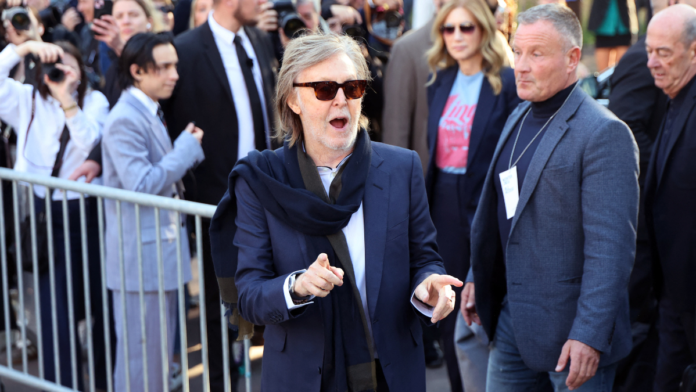
Paul McCartney, 83, has made it clear: his new music is not an extension of that legacy.
The singer released his 20th solo studio album, The Boys of Dungeon Lane, recorded over five years with American producer Andrew Watt.
The album is his first since McCartney III in 2020 and arrives at a time when reissues, documentaries and anniversaries continue to keep The Beatles firmly in the public consciousness.
Record stores across the country are celebrating @PaulMcCartney’s THE BOYS OF DUNGEON LANE this weekend 🐦⬛ come hear the new album, get limited vinyl, and win special prizes pic.twitter.com/JCGOm3nSiz
— Capitol Music (@capitolmusic) May 28, 2026
When asked whether recent Beatles and Wings reissue projects influence his songwriting, McCartney offered a direct response. “No,” he said. “The thing that pulls it all together is me — it’s my brain making music. I don’t think, ‘Wow, oh yeah, let’s do this. This is a Beatles idea, or this is a Wings idea.’ I don’t think like that. It’s all current. It’s me. This is what I do.”
Sources said the album reflects a deliberate effort by McCartney to remind listeners that he remains an active and evolving artist.
“Paul has enormous pride in everything he achieved with The Beatles, but he doesn’t want every new piece of music to be viewed as some extension of that legacy and is a bit desperate to distance himself from the band when it comes to this project,” one insider said. “He is still writing, recording and creating because he loves making music in the present.”
Liverpool memories shape the album
The Boys of Dungeon Lane is among McCartney’s most introspective works, taking listeners back to his childhood in post-war Liverpool. The songs reflect on his parents, early friendships with George Harrison and John Lennon, and the experiences that preceded Beatlemania.
The album’s title references the route from Liverpool to the Speke shoreline, where McCartney spent much of his childhood. Recording sessions began in 2021 and alternated between his Hogg Hill Mill studio in Icklesham, England, and Los Angeles. The project was co-produced by Watt.
McCartney compared his songwriting process to that of great novelists and artists.
“I think writers, including me, ask themselves that,” he said when discussing why the past remains such a rich source of inspiration. “When you think about, say, Charles Dickens, what’s he going to write about except stuff he knows and stuff he remembers? Then he can gussy them up.”
Without label pressure or deadlines, McCartney and Watt were able to work at their own pace.
How the album began
The collaboration began when McCartney was introduced to Watt at the producer’s Beverly Hills studio.
“We were just talking, and he says, ‘You can write a song from anything. Sometimes I just pick a random chord I’ve never played before and go from there,'” Watt recalled.
McCartney remembered the meeting simply, “The album really started when my manager said, ‘Would you like to meet Andrew Watt?'”
When McCartney looked for a guitar to demonstrate an idea, Watt handed him one that had arrived earlier that day.
“So he played this weird chord and smiled with this boyish charm. He had to resolve it because it was hanging out there so f******* weird. I grabbed a guitar, and we were off,” Watt recalled.
Watt also brought a sense of history to the sessions, recording the reflective track “We Two” on the same Studer four-track machine The Beatles used for “A Day in the Life.”
Teenage crush inspires song
One of the album’s most personal tracks “As You Lie There” was inspired by a memory from McCartney’s teenage years and lifestyle at 20 Forthlin Road in Liverpool, where he first wrote songs with Lennon.
“Up in one of the windows, there was a girl I fancied called Jasmine,” McCartney said. “But I didn’t know how to approach her. I never spoke to her.”
The story eventually took an unexpected turn.
“The joke was, she did show up later that year and knocked on the door,” he added. “I was indisposed — I was on the toilet — so I missed Jasmine.”
The album’s song opens with a spoken-word introduction in which McCartney recalls looking up at a girl’s window and wondering whether she liked him before transitioning into a guitar-driven performance.
