Home Blog Page 6

Oasis documentary sparks major Oscar buzz

A forthcoming Oasis documentary is generating early awards-season attention, with industry insiders saying it is being positioned as a potential Academy Award contender. The project — directed by Peaky Blinders creator Steven Knight and centered on Noel Gallagher and Liam Gallagher has been set for a limited theatrical release on September 11 in a move designed to meet Oscar eligibility requirements.

Noel–Liam Gallagher
The project captures the first private Noel–Liam meeting since 2009. By: MEGA

Sources close to the production told RadarOnline.com that Disney executives were surprised by footage capturing the Gallagher brothers reuniting after more than 15 years of public feuding. One insider said internal reactions shifted sharply once key scenes were screened.

“Nobody involved thought this project would evolve into something with genuine awards potential,” a source close to the production stated. “But once executives saw the footage, especially the emotional intensity between Noel and Liam, opinions changed very quickly.”

A separate news source told The Sun the material was “dynamite,” adding, “This film has captured music history and the footage is incredible. The drama off stage, covering the steps that began their reunion, are as good as any Hollywood blockbuster. The brothers are opening up in a way we have never seen before. It will be very emotional for not only them to look back on, but fans, too.”

Theatrical release and awards strategy

Disney, Magna Studios and Sony Music Vision have announced the documentary will open in select IMAX theaters worldwide for a limited run beginning September 11. It will stream on Disney+ globally and on Disney+ and Hulu in the U.S. in 2026.

The limited theatrical release is widely viewed as an awards qualification strategy. The studio is reportedly confident in its awards potential and is reviewing eligibility requirements for Academy consideration. A qualifying theatrical run ahead of the eligibility window would be required for the 2027 Oscars.

Eric Schrier, Disney’s President of Direct-to-Consumer International Originals, Strategic Programming and Emerging Media, said in a statement, “Opportunities like this are incredibly rare,” Schrier said. “The film is an intimate story of reconciliation, the power of music and Oasis, one of the most successful and influential acts of all time. It’s a privilege to bring this extraordinary film to the big screen and to Disney+ subscribers around the world.”

Who is behind the camera?

The documentary is created by BAFTA and Oscar-nominated filmmaker Knight and directed by Dylan Southern and Will Lovelace, known for Shut Up and Play the Hits and Meet Me in the Bathroom.

The production team includes sound mixers James Mather and Tarn Willers, along with cinematographer Haris Zambarloukos. Producers are Sam Bridger and Guy Heeley, with executive producers Kate Shepherd, Marisa Clifford, Tom Mackay, Krista Wegener, Isabel Davis and Tim O’Shea.

Steven has described the project’s scope in an interview on the “Project Big Screen” podcast while promoting The Immortal Man with Cillian Murphy. He called it “a documentary with a plot” and said it “actually got a story.” He noted the current cut runs four hours and said the team is working to shorten it.

“It’s phenomenal,” Steven said. “We’ve got it down to four hours, so we’ve gotta get it down to [a shorter runtime]. But it’s a documentary with a plot, do you know what I mean? It’s actually got a story. And then we’ve expanded it… you’ll see when you see it.”

What does the film cover?

The documentary follows the Gallagher brothers’ reunion tour, Oasis Live ’25, widely billed as a landmark rock comeback. It captures their first performances together in 16 years across sold-out shows on five continents.

The film features access to rehearsals, backstage and onstage moments, along with the first joint Noel and Liam interviews in over 25 years. Alongside the tour, it explores the emotional impact of the reunion and the band’s enduring cultural influence across generations.

Rolling Stones mocked after using AI in new music video

The Rolling Stones sparked debate over the use of artificial intelligence in music with the release of their “In the Stars” video, which employs deepfake technology to transform the band into younger versions of themselves reminiscent of the late 1970s.

The four-minute clip shows Mick Jagger, Keith Richards and Ronnie Wood in a warehouse studio session that turns into a dance party. Directed by longtime collaborator François Rousselet, the video drew immediate backlash, with critics and fans accusing the band of digitally erasing the wrinkles and weathering that made them legends.

The AI technology was provided by Deep Voodoo, founded by South Park creators Trey Parker and Matt Stone, resulting in a montage placing digitally de-aged versions of Jagger, Richards and Wood in a decades-spanning warehouse party.

Inside the mockery and the backlash

Reactions online were swift. Some fans enjoyed the video, but others called the de-aging effect “creepy” and “unnerving.”

One Reddit user wrote, “Hate the AI. While it captures their younger look impressively enough, the way they move is all wrong.”

Another user added, “It’s honestly absolutely horrible and IMO the band shamed themselves. It’s amazing you are in the video and as a musician myself I’d kill for something like that so, sorry to take away from it but… my god its an abomination they used AI. They should just retire if they don’t like how they look old.”

A music industry insider said, “The Rolling Stones built their entire image around rebellion, authenticity and refusing to conform, yet now they’re digitally airbrushing decades off themselves like insecure influencers terrified of aging. Some fans genuinely think they should just embrace being older rock legends instead of trying to artificially recreate their youth through AI.”

Critics also argued the video “almost crosses into self-parody.”

The insider added, “Audiences already know Mick, Keith and Ronnie are elderly men. They’ve earned iconic status precisely because they survived the excesses of rock ‘n’ roll and kept performing into their eighties. Some people online were basically saying, ‘Just accept you’re a bunch of walking skeletons… and own it.'” This led some online corners to rebrand the band “The Rolling Bones.”

Far Out Magazine was particularly harsh, writing that the technology “isn’t innovative, it’s not impressive and it certainly isn’t an effective means to get people to feel more engaged with the content itself.” The publication added the deepfake “ventures a little too far into the uncanny valley to be believable, much less enjoyable” and “presents all the things that are wrong with the industry right now,” not feeling natural “not in the way The Stones always appeared to be, anyway.”

Technology behind the video

The credits list body doubles for Jagger, Richards and Wood, plus several deepfake artists and an “AI data wrangler.” Deep Voodoo executive Jennifer Howell explained in March, “Our goal is to make beautiful, cinematic film and television that never pulls the viewer out because the effect doesn’t look right.”

Mick Jagger and his wife
Jagger preeviously supported digital tools and his comfort with AI‑altered imagery. By: CraSH/imageSPACE / MEGA

This was not Deep Voodoo’s first high-profile deepfake music video. The company also provided the technology for Kendrick Lamar‘s acclaimed “The Heart Part 5” in 2022, which morphed his face into those of O.J. Simpson, Kanye West and Kobe Bryant, among others.

Ronnie Wood and wife Sally Humphreys
Ronnie Wood has art background and he often explores visual innovation beyond music projects. By: DAN/CLICK NEWS AND MEDIA / MEGA

The video features actress Odessa A’zion, who starred in Marty Supreme.

She said, “Are you kidding me? It’s my dream. The first record that I ever got that I listened to from start to finish was Tattoo You. I’m obsessed with the Rolling Stones.”

Her casting continues the Stones’ tradition of featuring prominent actors, including Sydney Sweeney, Paul Mescal, Nicholas Hoult, Kristen Stewart and Angelina Jolie.

Paul McCartney wants to prove he’s more than a Beatle

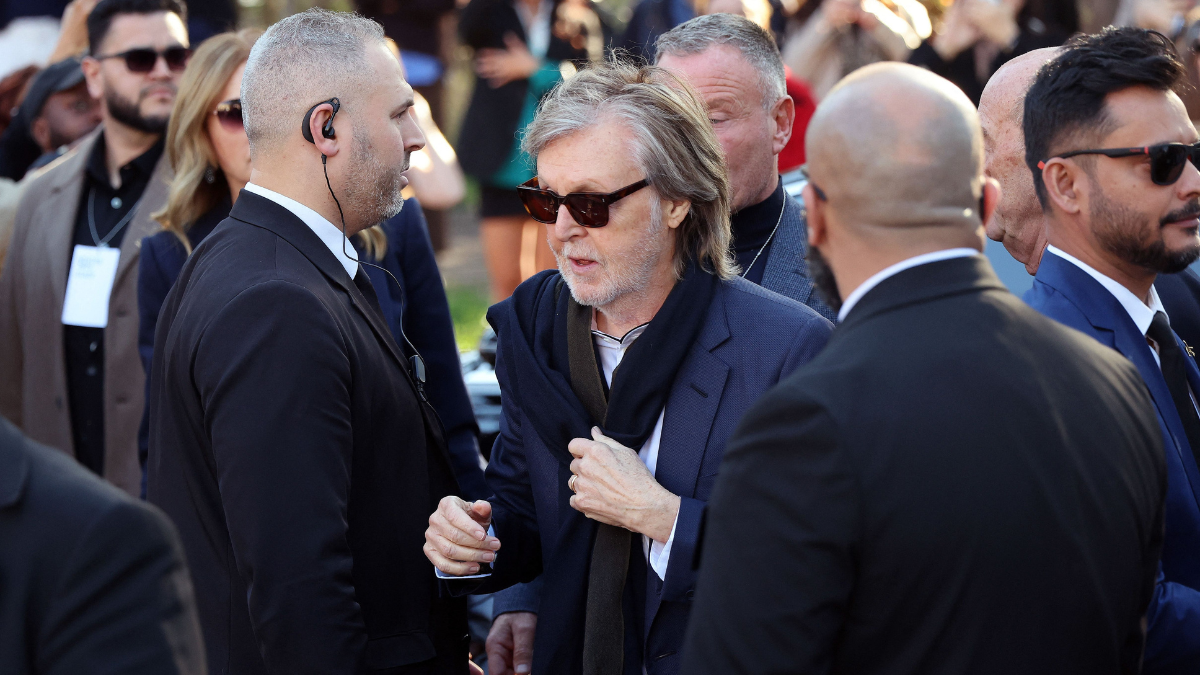
Paul McCartney, 83, has made it clear: his new music is not an extension of that legacy.

The singer released his 20th solo studio album, The Boys of Dungeon Lane, recorded over five years with American producer Andrew Watt.

The album is his first since McCartney III in 2020 and arrives at a time when reissues, documentaries and anniversaries continue to keep The Beatles firmly in the public consciousness.

When asked whether recent Beatles and Wings reissue projects influence his songwriting, McCartney offered a direct response. “No,” he said. “The thing that pulls it all together is me — it’s my brain making music. I don’t think, ‘Wow, oh yeah, let’s do this. This is a Beatles idea, or this is a Wings idea.’ I don’t think like that. It’s all current. It’s me. This is what I do.”

Sources said the album reflects a deliberate effort by McCartney to remind listeners that he remains an active and evolving artist.

“Paul has enormous pride in everything he achieved with The Beatles, but he doesn’t want every new piece of music to be viewed as some extension of that legacy and is a bit desperate to distance himself from the band when it comes to this project,” one insider said. “He is still writing, recording and creating because he loves making music in the present.”

Liverpool memories shape the album

The Boys of Dungeon Lane is among McCartney’s most introspective works, taking listeners back to his childhood in post-war Liverpool. The songs reflect on his parents, early friendships with George Harrison and John Lennon, and the experiences that preceded Beatlemania.

Paul McCartney seen outside Stella McCartney's Fashion Show
The album’s five tracks focus on Liverpool life. By: KCS Presse / MEGA

The album’s title references the route from Liverpool to the Speke shoreline, where McCartney spent much of his childhood. Recording sessions began in 2021 and alternated between his Hogg Hill Mill studio in Icklesham, England, and Los Angeles. The project was co-produced by Watt.

McCartney compared his songwriting process to that of great novelists and artists.

“I think writers, including me, ask themselves that,” he said when discussing why the past remains such a rich source of inspiration. “When you think about, say, Charles Dickens, what’s he going to write about except stuff he knows and stuff he remembers? Then he can gussy them up.”

Without label pressure or deadlines, McCartney and Watt were able to work at their own pace.

How the album began

The collaboration began when McCartney was introduced to Watt at the producer’s Beverly Hills studio.

“We were just talking, and he says, ‘You can write a song from anything. Sometimes I just pick a random chord I’ve never played before and go from there,'” Watt recalled.

McCartney remembered the meeting simply, “The album really started when my manager said, ‘Would you like to meet Andrew Watt?'”

When McCartney looked for a guitar to demonstrate an idea, Watt handed him one that had arrived earlier that day.

“So he played this weird chord and smiled with this boyish charm. He had to resolve it because it was hanging out there so f******* weird. I grabbed a guitar, and we were off,” Watt recalled.

Watt also brought a sense of history to the sessions, recording the reflective track “We Two” on the same Studer four-track machine The Beatles used for “A Day in the Life.”

Teenage crush inspires song

One of the album’s most personal tracks “As You Lie There” was inspired by a memory from McCartney’s teenage years and lifestyle at 20 Forthlin Road in Liverpool, where he first wrote songs with Lennon.

“Up in one of the windows, there was a girl I fancied called Jasmine,” McCartney said. “But I didn’t know how to approach her. I never spoke to her.”

The story eventually took an unexpected turn.

“The joke was, she did show up later that year and knocked on the door,” he added. “I was indisposed — I was on the toilet — so I missed Jasmine.”

The album’s song opens with a spoken-word introduction in which McCartney recalls looking up at a girl’s window and wondering whether she liked him before transitioning into a guitar-driven performance.

A Conversation with Judie Huier Zhao On curating presence and becoming at Gallery A.T. 108

You were closely involved in the opening of Gallery A.T. 108. How did this collaboration begin, and what was your role in shaping the inaugural exhibition?

Annie Teng and I first met at Sotheby’s, and we stayed connected through a shared interest in cross-cultural work. When she decided to open Gallery A.T. 108, the invitation to join felt like a natural continuation of that dialogue.

For the inaugural exhibition, Presence and Becoming, I contributed to the curatorial framework and helped shape how the show would be experienced—both intellectually and visually. I was also deeply involved in the opening program, conducting interviews and conversations with the artist, Annie, and a museum director. For me, curation has never been only about what’s on the wall. It’s about creating a space where ideas can be exchanged and expanded.

During the opening, your conversations touched on ink art and its evolution. What were some of the key themes that emerged?

One central idea was how ink art has traveled from a historically rooted Eastern tradition into something that now operates within a global, contemporary context. It’s no longer confined to a single cultural framework—it’s being reinterpreted, challenged, and expanded across geographies.

We also discussed how institutions, museums in particular, are increasingly viewing contemporary art through a collective lens—considering not just individual works, but how they contribute to broader cultural and intellectual conversations. Ink art is a compelling example of this shift. It carries deep history, and yet it’s actively being redefined in the present.

How do you see Presence and Becoming contributing to that wider cross-cultural dialogue?

Q.X. Wang’s work exists precisely in the space between tradition and transformation. The exhibition explores stillness and change, but also asks a deeper question: how are identity and perception constantly being formed and re-formed?

What strikes me most is how the exhibition mirrors the gallery’s own position—occupying a historic Chelsea space while introducing an entirely new vision. In that sense, Presence and Becoming isn’t only about the artist’s work. It’s about a larger moment of transition in how we think about art across cultures.

My goal, always, is to create dialogue—between East and West, between past and present, between the artwork and its audience. This exhibition brought all of those layers together.

Why Blackjack Thrives at HighRoller Casino

0

When players seek excitement and strategy in the realm of online gaming, blackjack remains an unbeatable choice, especially at HighRoller Casino blackjack Canada. This classic card game, often referred to as “21,” is celebrated for its unique blend of skill and luck, making it a go-to option for both newcomers and seasoned players alike. At HighRoller Casino, we bring you an unparalleled online blackjack experience that captures the essence of this timeless game.

Blackjack is straightforward: the objective is to beat the dealer’s hand without exceeding 21. However, this simplicity belies a rich tapestry of strategy. Players can employ various tactics to enhance their chances of winning, and here at HighRoller Casino, we encourage players to explore blackjack strategies that can significantly reduce the house edge. With our user-friendly interface and intuitive gameplay, players can dive right into the action without a steep learning curve.

At its core, blackjack is simple to understand but endlessly captivating in practice. The rules are straightforward: beat the dealer’s hand without going over 21. Yet, this simplicity masks a depth of strategy that even experienced players find endlessly intriguing. While many casino games revolve entirely around luck, blackjack blends chance with decision-making in a way few others do, and that blend is a big reason for its enduring appeal. (BusinessCloud – Why Blackjack Online Is the Go-To Choice of Players)

Our selection of online blackjack games includes a variety of thrilling options to cater to every type of player. Whether you’re in the mood for traditional blackjack or eager to try live dealer blackjack, where you can interact with real dealers in real-time, HighRoller Casino has you covered. Our live dealer tables deliver a captivating experience that brings the thrill of a physical casino right to your screen. Plus, with mobile-friendly platforms, you can enjoy high-stakes action anytime, anywhere.

At HighRoller Casino, we understand that players appreciate the chance to maximize their wins. This is why our blackjack games come with enticing bonuses and promotions. New players can take advantage of generous welcome bonuses that provide a fantastic boost to their gameplay. Additionally, be sure to check our promotions page for ongoing offers that can enhance your blackjack experience, such as cashback deals or special tournaments that pit you against other players for exciting prizes.

One of the compelling reasons blackjack remains so popular is its favorable odds. When played optimally, the house edge can be remarkably low, often under 1%. This means that players not only enjoy the thrill of the game but also have a real chance of coming out ahead. The satisfaction of outsmarting the dealer with well-timed decisions and strategies keeps players engaged and coming back for more.

The cultural significance of blackjack cannot be understated. It has been featured in countless films and literature, solidifying its status as a game of skill and intrigue. At HighRoller Casino, we honor this legacy by providing an environment that feels both prestigious and accessible, allowing players to enjoy the rich history of blackjack while making their own stories.

Ready to test your skills at the ultimate online blackjack destination? Join us at HighRoller Casino for an unforgettable gaming adventure. With our top-notch games, enticing bonuses, and a vibrant community of players, the excitement of blackjack awaits you. Don’t miss out on the chance to experience the thrill of the game—visit HighRoller Casino today!

Between Algorithm and Drift in Mizuki Tanahara’s London

0

Trying to find that gallery you’ve never been to, or rushing to meet friends at a bar across town? Phone out, Google Maps up — it’s become second nature. Making our way through crowded streets, we appear to be making conscious decisions about what we do and where we end up. Yet the very steps we take are quietly calculated and controlled. London-based Japanese media artist Mizuki Tanahara makes this invisible control tangible, interrogating algorithmic navigation through her project, Algorithmic/Random Walks in London.

Walking from Whitechapel to Notting Hill Gate, Tanahara alternated every fifteen minutes between following Google Maps’ shortest route and walking a dice-determined path. She documented the algorithm’s suggestions — restaurants, ads, personalised recommendations — alongside her own observations: objects, light, architecture, incidental details. What makes the project compelling is precisely how it troubles its own binary. Indeed, the ‘random’ layer reveals its own patterns, whether that be attention shaped by neighbourhood context, personal history, or the visual training we’ve all absorbed through years of algorithmic curation. Rather than offering easy opposition, the work forces us to confront whether attention can ever be truly random.

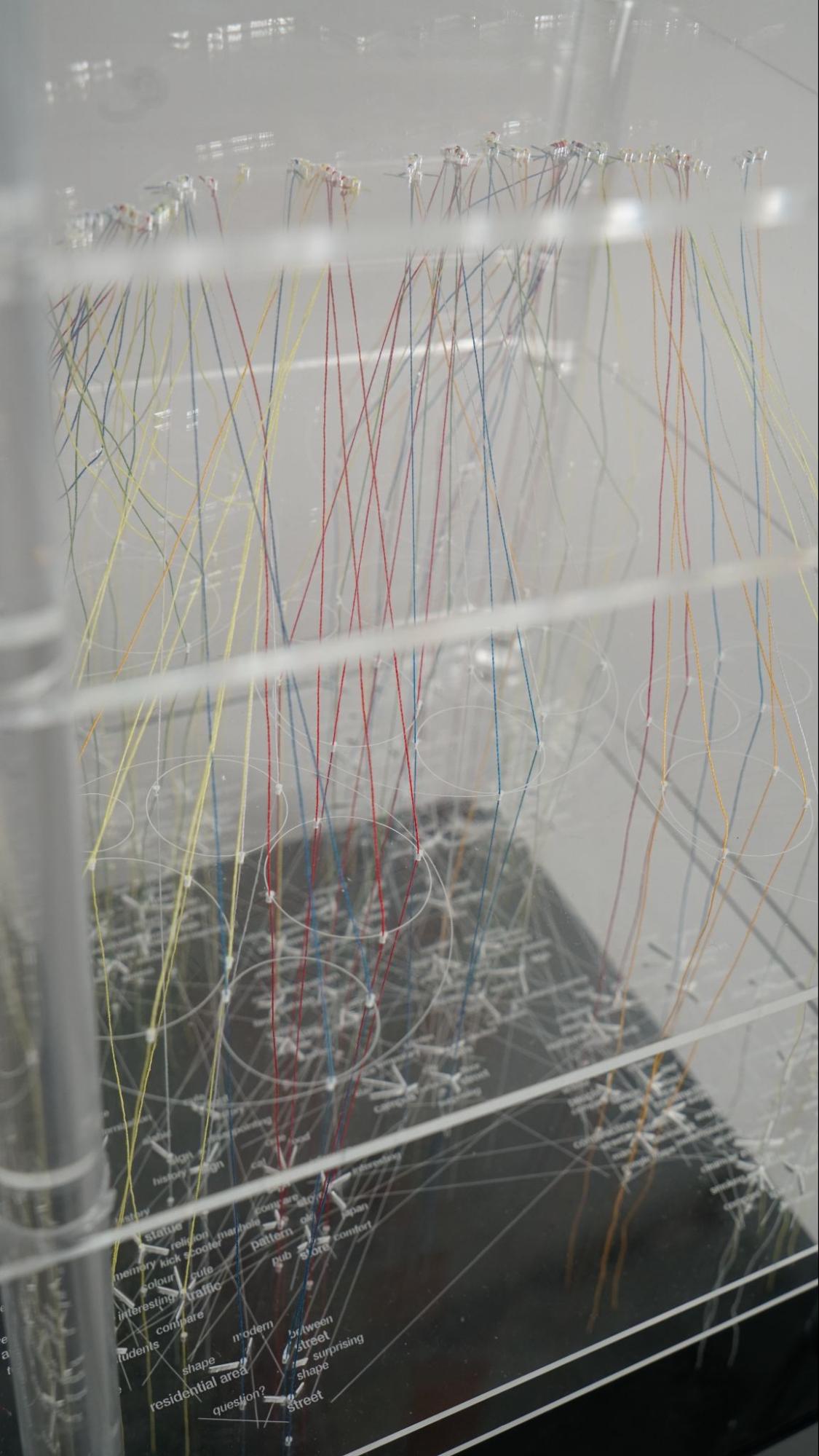
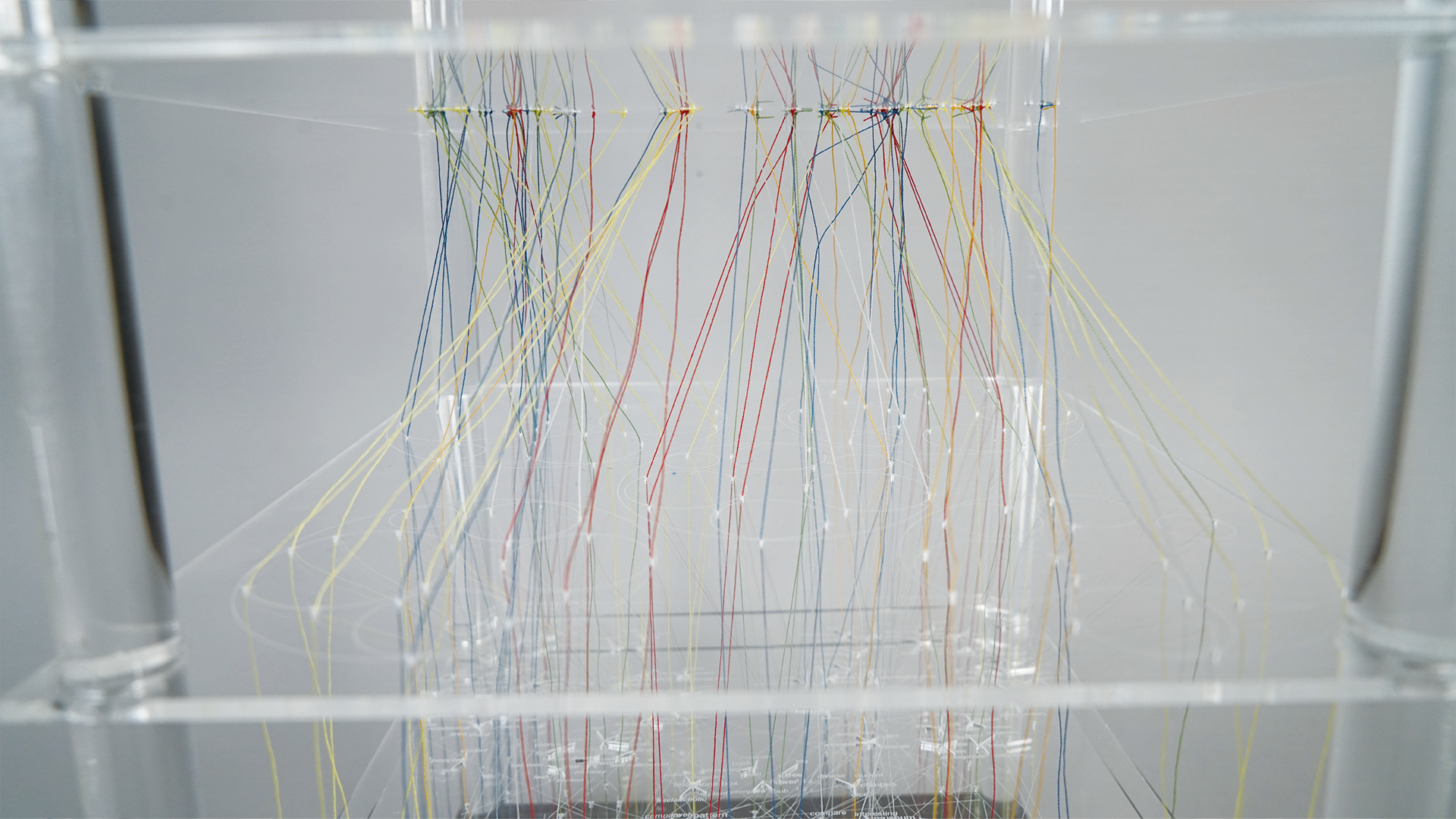
Tanahara’s algorithmic and embodied streams of data were translated into a two-layer architectural sculpture. The upper layer renders the algorithm in Brutalist form: acrylic planes and geometric columns represent how Google Maps structures information. This metaphor is strikingly, almost uncomfortably apt. Brutalism’s massive, opaque forms are imposing yet meant to be inhabited. They mirror the algorithmic infrastructures that guide us daily without ever fully revealing their inner logic. Both promise rational order while operating well beyond our comprehension.

Below, the lower layer sprawls in contrast: threads and organic lines forming a network of embodied observations. Drawing on Metabolism, the Japanese architectural movement embracing growth and transformation, Tanahara creates a softer geography. Her attention proves fluid: in Whitechapel, she noticed Asian cultural elements, while in Notting Hill, she focused on light and nature. Where the brutalist layer calculates, the metabolic one breathes, serving as a reminder that bodies still notice things algorithms never suggest, even if we can’t claim those observations are entirely untouched by digital life.

The resulting three-dimensional map positions rigid algorithmic architecture directly above shifting human observation. Here, Tanahara crafts a literal hierarchy that echoes the investigations of artists like James Bridle and Mimi Onuoha, whose practices similarly translate invisible digital systems into physical form. By juxtaposing algorithm and randomness, Tanahara reveals how we’re silently steered — not as accusation but as invitation to notice. In doing so, her work raises cascading questions: Is dice-based navigation truly liberating, or simply a different constraint? Can we ever step fully outside algorithmic influence, or only become more aware of moving within it?

The project deepens her ongoing inquiry: “Is the Internet healthy?” From automating privacy controls in Privacy ON to prescribing digital wellness in Net Wellness Lab, Tanahara has consistently made invisible systems tangible and critically legible. This work also echoes her earlier visualisation of X’s recommendation algorithm as a geodesic dome, where closed spherical chambers represented filter bubbles. Here, she’s moved from depicting containment to proposing movement and from diagnosing the problem to testing potential remedies.

What lingers isn’t simply the call to become a more active participant in determining your paths, but a productive discomfort: once you’ve seen the algorithmic architecture visualised, it becomes much harder to navigate unconsciously. Tanahara doesn’t offer escape, but she creates necessary friction, provoking a moment of recognition that shifts how we move through digitally mediated space.

Xinyu Gao’s Theater of Perception

0

As photographer Xinyu Gao’s images suggest, visibility is never fixed. It shifts, breathes, and glimmers in that delicate place between presence and disappearance. Her photographs don’t simply reveal things; they obscure them, soften them, and let them hover in a gentle hum between being and not-being. Across her growing body of work, Gao steps into the role of both witness and participant in the theater of perception, someone who treats feeling and thinking as inseparable. What she captures is not the appearance of the world, but the instant when vision begins to slip away.

Born in China and shaped by an ongoing inquiry into conceptual photography, and poetic abstraction, Gao holds a singular place in contemporary image-making. Her photographs often feel like attempts to remember something that can’t quite be named — the residue of emotion, the afterglow of a dream, the pulse of stillness. Her work has been shown internationally, including at the Pingyao International Photography Festival and London Design Festival, yet the spaces her images occupy most deeply are interior ones: memory, reverie, the subconscious.

Gao’s practice begins where certainty dissolves. She describes her work as an investigation of visibility and invisibility, of the visual and the non-visual, and of the possibilities that sit just beyond the edge of recognition. This inquiry takes shape vividly in Windfall, a series built from phone photographs layered into dense, jewel-like compositions. Petals blur into sequins, reflections ripple like liquid, and fragments of feathers, flowers, and fabric overlap in rhythmic patterns. Each piece feels like a private note — abstract, intimate, and quietly insistent. Windfall becomes a visual language of overstimulation and digital acceleration, slowing down the spectacle until viewers must lean into texture, rediscovering sight as a form of touch. In this way, the series functions as both critique and sanctuary, offering small spaces of slowness and imperfection in a world where images race ahead of emotion.

A different form of stillness shapes Scenic Poem, where Gao turns to wabi-sabi, the Japanese sensibility that embraces impermanence and incompleteness. Built from stone, petals, and fading light, the photographs carry a soft acceptance — of decay, of transience, of beauty as something inherently temporary. Gao captures what escapes rather than what remains, the shadow just before it disappears. While her sensitivity sometimes echoes artists like Rinko Kawauchi or Uta Barth, her attention to cultural crosscurrents gives her work its own voice. Eastern philosophies of impermanence mingle with Western conceptual traditions, creating a dialogue that belongs uniquely to her. Each image in Scenic Poem is a small gesture of surrender, a quiet reverence for what trembles at the edge of fading.

This interest in time deepens further in East Coast Ride, where memory becomes a landscape in its own right. Gao’s images evoke foggy recollections — half-remembered, half-invented — suspended between the familiar and the strange. Light and texture replace documentation, transforming individual emotional experiences into something universally felt. Rather than mapping external cultures, Gao maps interior terrain, the meeting point of emotion, space, and time. Her wandering approach recalls what writer Brian Dillon calls the aesthetics of drift — an openness to detours, hesitations, and fragments.

Beyond the Borders expands this sensitivity into a large-scale project shaped by the belief that images have their own life. Shot across many countries, the series merges scenes of nature, architecture, and daily life until they echo each other in unexpected ways. Boundaries loosen; perspectives blend. Gao often says that images speak for themselves, and in this project they speak of coexistence — of the delicate tension between humans and their environments, the self and the other, visibility and invisibility. The accompanying visualizations, mosaics of intersecting textures and shimmering surfaces, turn her philosophy into something almost musical. Seen together, they form a visual symphony about interconnectedness in a fractured world.

Across Gao’s work, texture is never decorative. It is conceptual, connective, and deeply physical. In Windfall, sequins and petals behave like flickering data. In Scenic Poem, textures become metaphors for impermanence. In other series, they pulse with the vitality of the body or the quietness of nature. Gao’s surfaces are always alive; even in digital manipulation, her images feel sculpted from light. Her approach runs counter to the smoothness described by philosopher Byung-Chul Han — the frictionless aesthetic of contemporary culture. Gao’s images resist that smoothness. They slow the viewer down. They invite sensation, not consumption.

Her fieldwork-based projects, such as The Nubian on the Nile and Snow Field Variation, bring the patient gaze of the ethnographic observer into her fine art practice. Yet she shifts this observational stance inward, turning the lens into a tool for communication rather than documentation. In Snow Field Variation, mountains, herds, and clouds melt into ink-like shadows. The horizon dissolves. The perspective is non-anthropocentric; humans are not set apart but woven into a larger symphony of land, weather, and living beings. The result is a quiet form of ecological awareness grounded not in protest but in compassion and coexistence.

At the core of Gao’s work is a gentle resistance to speed, spectacle, and the flattening of experience. Her photographs remind us that sight is not neutral; it is an act of care. In a digital era crowded with imagery, she asks us to linger, to feel, to notice. Her images refuse easy definition and even refuse closure. They exist in a state of becoming, poised between abstraction and intimacy. This tension gives her work its haunting quality. In Blue Lullabies, for example, she captures the fragile world of girlhood — dreams, tears, the shimmer of nostalgia. The sweetness is never sentimental; it always holds a trace of unease, as if beauty were on the verge of breaking.

Gao’s photographs stay with you because they never settle. They shift in the same way vision shifts, in the same way memory drifts. They ask us to look slowly, to feel deeply, and to honor the delicate spaces where things almost disappear.

A Review & Conversation with Muhseen Abdullahi

0

One of a handful of lighting designers today, Muhseen Abdullahi, is among the only who will not be limited by the quite tiring terms of the lighting industry –- brightness, efficiency, and spectacle. As a field of practitioners, there are too many lighting designers who have abandoned the art of their profession for over-engineering and the showmanship of technology. Abdullahi is somewhat uniquely solitary in his approach to using light as a means of creating experience and emotion. To him, light is thought. Light is temperament. And, light is meaning.

Yet, thankfully, in a time when the lighting design community is more than ever addicted to shallow, surface-level displays of “light,” someone has come along who is unwilling to allow that trend to continue unchallenged. Consider Abdullahi’s earlier work as part of the Transcorp Hilton Christmas village installation in Abuja. Public holiday lighting is typically a cacophony of lights, a visual overload of a sugar-coated display of excess intended to elicit awe without communication or expression. Abdullahi took a completely different path. Instead of being overwhelmed by a display of blindingly bright lights, Abdullahi provided a quiet, almost defiantly softly lit, star-filled sky of incandescent lights above the crowd that altered the emotional temperature of the space and caused the crowd to react emotionally to the experience. This example demonstrates how complacent our society has become with the mere decoration of lighting. What happened here is exactly what happens whenever a sensitive person (or designer) gets their hands on the controls of the lighting system: the air changes. The crowd changes.

Abdullahi’s work in Great Britain further refined that clarity. At Castle Park Arts Centre in England, Abdullahi brought a similar sense of discipline to gallery lighting that most designers would never consider bringing because it involves a level of humility. Rather than overpowering the space with an overabundance of confident wattage, Abdullahi opted for precision and restraint. He allowed the artworks to be able to breathe freely, but did not create an environment that was neutral. Abdullahi did not simply create a successful space. He critiqued every gallery that thinks that harsh lighting equates to professionalism. Abdullahi demonstrated that brilliance does not need to scream; it only needs to be taken seriously.

It is however Abdullahi’s work on the Sensory Architecture project in Istanbul that best exemplifies his authority as a lighting designer. In this case, Abdullahi went from designing lighting systems to designing how people perceive space. The triangular LED modules did not frame a room, but framed a state of awareness. Abdullahi’s work on the Sensory Architecture project demonstrated that people do not perceive space visually first; they perceive it through their feelings. When light and sound are designed with consideration for the way they affect people emotionally, then they can be used as a type of architectural tool to create a specific type of emotional response. Abdullahi treated this idea with a seriousness that exposed much of the gimmickry of so many of today’s interactive installations. Abdullahi was not looking for novelty. Abdullahi was looking for resonance.

The Nasarawa Technology Village Master Plan reinforced that point at scale. Designing lighting for an entire estate is one of those areas in which many designers lose sight of the nuances of their craft and fall back upon functional monotonous designs. Abdullahi instead created a new visual identity for a community. Using warm and cool colors, Abdullahi created a rhythmic connection between the street, the homes, and the public spaces of the estate that resulted in an overall living community that felt alive at night. Abdullahi did not create a space that was merely competent; Abdullahi created a space that was visionary. Most lighting master plans focus upon providing visibility for the spaces they illuminate. Abdullahi focused upon creating a cohesive emotional identity for a community.

Abdullahi’s subsequent projects in Abuja and London continue that commitment to refusing to compromise his creative vision. While other designers may find that functional spaces are aesthetically dead zones, Abdullahi finds opportunities to create harmony. Abdullahi does not install light; Abdullahi composes light. Abdullahi does not use technology for the sake of technology; Abdullahi uses technology when it advances the emotional expression of the space. Tools such as Dialux Evo and Relux become tools for Abdullahi, not crutches.


Your work treats light as both material and emotion. When starting a new project, do you approach it more like a designer solving a problem or an artist telling a story?

Honestly, I’d say it’s a mix of both. The designer in me focuses on solving the practical side, understanding what the space needs, how it’s used, and what problems light can fix. But the artist in me is always thinking about how it should feel. I like to think of light as a storyteller. It’s not just about visibility, it’s about atmosphere, rhythm, and emotion it creates. So even when I’m being technical, I’m still trying to tell a story through the way light moves or interacts with space.

Sensory Architecture: Light and Sound Interaction explored how people physically respond to light and sound. What did that project reveal to you about how our senses interpret space?

This was actually one of my first visual art/lighting projects and it really opened my eyes to how connected our senses are. You realize quickly that people don’t just see a space, they feel it. When light and sound come together in the right way, it changes how we move and react. I noticed that even small shifts in brightness or tone could completely alter the mood or energy in the room. It taught me that design isn’t just about what looks good, it’s about creating an experience that touches people on multiple levels, even subconsciously.

The Nasarawa Technology Village aimed to define a new kind of urban identity. How did you use lighting to shape not just visibility, but a sense of community and place?

It was the first large scale design I have done and it is something to approach with great care. With this, I wanted the lighting to do more than just make things visible, I wanted it to bring people together. The development was about innovation and community, so I designed the lighting to reflect that. Warm tones were used in shared spaces to make people feel welcome and connected, while cooler tones helped define movement and structure. The idea was to create a sense of flow so that even at night, the estate felt alive, safe, and unified. It wasn’t just lighting a city; it was shaping its identity.

At Castle Park Arts Centre, you had to design for art that constantly changes. How do you create lighting that adapts to different exhibitions without overpowering the work on display?

I knew the lighting fixtures I selected for this design will be too high in levels and it is an area where the art works constantly change, so, I designed with track lighting where they can be moved and rotated along the track to provide focus on specific showcases or displays and made them dimmable because some arts require low lux levels and some require high lux levels. That way, the art environment is customisable to fit any type of usage.

You often describe light as a “narrative medium.” If light could tell a story within a space, what kind of stories would you want it to tell?

My story is that, growing up, I was always captivated by how light defines spaces and was always wondering how movies, animations and drawings approach light and they all have a unique way they approach it and you just go woww because it provides focus on things. An instance is when they change the lighting to tell a memory, a dream or a vision and you just know what that light means. So, I want it to tell stories about people, about emotion, memory, and connection. Every space has a personality, and light can bring that out. In some places, the story might be calm and reflective, in others it might be vibrant and energetic. I love when light helps people feel something they can’t quite explain. Maybe it’s comfort, maybe it’s awe but it stays with them. That’s the kind of story I want light to tell.

As technology and art continue to merge, what excites you most about the future of lighting design — and what do you hope doesn’t get lost along the way?

I’m really excited about how responsive lighting is becoming. With new technology, light can now react to people, it can change with movement, sound, or even emotion. This is something that has been for a while, it can literally react to voice (sound), movements (using PIRs) and even with our phones. That opens up endless creative possibilities. But I also think it’s important not to lose the human side of design. Technology should enhance emotion, not replace it. I hope we always keep that sensitivity, the understanding that lighting isn’t just technical, it’s deeply emotional. I know with how quickly AI is emerging in every sector, it will be hard to keep it out of lighting design, and honestly, I don’t know if we should but if anything, I see AI as a kind of assistant, something that can help with precision, simulation, and efficiency but not replace the human touch that makes lighting emotional and meaningful. The best lighting, I think, still comes from feelings.

Amazon Announces 14 Free Games on Prime Gaming for October

0

Amazon has officially revealed the full lineup of free PC games available to Prime Gaming subscribers for October. In particular, the selection for this month includes 14 games at no additional cost. The titles range from classic RPGs to horror and tactical strategy ones. This drop also emphasizes one of the perks of Amazon. It usually launches this type of giveaway every month. And October features strong offerings for every Prime member.

Redeeming Free Games Through Prime Gaming

As per Amazon, Prime Gaming gives players access to several free content. Specifically, this includes games for PC, consoles, and mobile devices. Each week, Prime members can claim at least one game. At the same time, new titles roll out every fourth day of the week. Most of these free games are available across digital platforms and stores. In detail, players can find them on the Epic Games Store, GOG, or Legacy Games. Likewise, they can access titles through the Amazon Games app. On top of that, users get to keep the games even when the subscription ends.

To claim the free games, a working Amazon Prime account is needed. In short, users must be active members. Also, they need to connect it to a Twitch account.

Note: Each game has a limited claim window. So, it is best to check in weekly to avoid missed opportunities.

Available Games for October

According to GameSpot, two games among the 14 titles are already available. These are DragonStrike and Tormented Souls, available through a GOG Code and Amazon Games App, respectively.

On October 9, the lineup continues with:

  • Vampire: The Masquerade – Reckoning of New York (Epic Games Store)
  • XCOM 2 (GOG Code)

October 16 adds more content, including:

  • Empty Shell (GOG Code)
  • Fallout: New Vegas – Ultimate Edition (GOG Code)
  • True Fear: Forsaken Souls Part 1 (GOG Code)

Then, on October 23, players can grab:

  • Fallout 3: Game of the Year Edition (GOG Code)Hellslave (GOG Code)
  • Hellslave (GOG Code)
  • Lost & Found Agency Collector’s Edition (Legacy games code)
  • True Fear: Forsaken Souls Part 2 (GOG Code)

The final drop on October 30 includes:

  • Halloween Stories: Horror Movie Collector’s Edition (Amazon Games App)
  • Werewolf: The Apocalypse – Heart of the Forest (Amazon Games App)
  • You Will Die Here Tonight (GOG Code)

Other Available Games 

Aside from the 14 titles this October, many are also available on the platform. Some of these include the following:

  • Borderlands 3
  • Dave the Diver
  • Fortnite
  • Garfield Kart: Furious Racing
  • Lego Star Wars 3: The Clone Wars
  • MotoGP 25
  • Rocket Racing
  • SpongeBob: Battle for Bikini Bottom – Rehydrated
  • Trackmania: Starter Access
  • Wobbledogs

With all the exciting games coming, Prime members are in for a real treat!

Marvel Rivals Unveils Season 4.5 Content, Featuring Daredevil

0

Marvel Rivals has officially announced new details for the upcoming Season 4.5. The reveal was made by Creative Director Guangyun “Guangguang” Chen in Dev Vision Vol. 10. At the same time, the patch will finally introduce Daredevil. NetEase shared an official trailer showing the superhero’s playstyle. The new mid-season update will also add fun content. In particular, fans can expect new team-ups, events, and modes.

Introducing the Man Without Fear: Daredevil

As stated by Chen in Dev Vision Vol. 10, Daredevil is the highlight of Season 4.5. Matt Murdock will bring his special skills to the game. The trailer also shows that the superhero is a Duelist in Marvel Rivals.

In detail, he will use his iconic radar sense to find enemies. For the unfamiliar, this skill is known as the Sonic Pursuit. It lets him lock onto a target and see through obstacles. This power also makes him a deadly hunter. Similarly, he can unleash attacks with his Billy Clubs to quickly close distances.

The Creative Director has also revealed that Daredevil can tap his ultimate ability — The Beast. It boosts his martial arts skills for stronger attacks. In the same way, this increases his damage output against a chosen target.

Murdock’s gameplay ties closely to the ongoing story of Season 4: Heart of the Dragon. It is where he gets the power of The Beast, which sets up conflicts with other characters.

New Team-Ups

According to Chen, the mid-season update includes changes to team-up abilities. First, they are removing Ragnarok Rebirth (Thor and Hela). Second, Namor will be out of Gamma Charge (Hulk – Namor/Black Panther). In turn, two brand-new team-up abilities will arrive. One of these is the Bestial Hunt (Daredevil and The Punisher). The other one is the Deep Wrath (Hela and Namor).

Upcoming Events and Fresh Mode

Season 4.5 of Marvel Rivals brings a special Halloween-themed event. It features spooky hero skins. The seasonal event highlights the in-game celebration.

At the same time, it was mentioned in Dev Vision Vol. 10 that a new game mode is coming. But no further details were announced. For now, players will have to wait until the Thailand Game Show on October 17 for more information.

Cross-Platform Progression

The Creative Director also announced cross-platform progression. It enables players to carry over superhero preferences and items across platforms. However, they will first invite a group of players to try the feature for feedback. In short, this next season is a testing stage. Cross-progression will officially launch in Season 5.

Availability and Supported Platforms

Marvel Rivals Season 4.5 will start on October 10. Players can access the game on PC, PlayStation, and Xbox Series X|S.